Indian sandstone is a sedimentary rock formed over millions of years from compressed sand, silica and natural minerals. The colour of each slab is determined by the minerals it contains: iron oxide produces the warm browns and reds, manganese contributes the greens and greys, while quartz gives the lighter creams and buffs their brightness. The result is a stone with genuine, non-repeating natural character — no two slabs are identical, which is part of its appeal.
In the UK paving market, Indian sandstone has become the dominant premium choice for patios, garden paths and courtyards. Three factors explain this. First, the stone is extraordinarily durable: a properly laid Indian sandstone patio will easily last over 25 years with only routine maintenance. Second, the colour palette is broader than almost any other natural stone available at a comparable price. And third, the UK market has matured to the point where ethically sourced, calibrated, hand-cut Indian sandstone can be bought online with free delivery for less than the cost of mid-range concrete block paving.
For homeowners, the practical takeaway is this: Indian sandstone delivers the aesthetic of genuine natural stone — which neither concrete imitations nor porcelain stone-effect tiles can fully replicate — at a price point that fits a typical garden budget.
The overwhelming majority of Indian sandstone supplied to the UK is quarried in Rajasthan, in the north-west of India. A smaller proportion comes from Madhya Pradesh and Bihar. The stone has been used in Indian construction for centuries — the same geological formation supplied the stone for the Red Fort in Delhi and parts of Fatehpur Sikri — and the industry today combines that long heritage with modern cutting and calibration facilities.
Slabs are usually quarried in large blocks, then hand-cut to size using traditional methods. The hand-cut edge — slightly irregular, with the natural fracture lines of the stone visible — is one of the defining aesthetic characteristics that distinguishes genuine Indian sandstone from machine-sawn imitations.
At Lesta Paving we visit the quarries we work with at least once a year. This direct relationship is what makes ethical-sourcing claims credible: it is the only way to verify, in person, that the stone we sell comes from operations that meet fair-trade and labour standards. We will come back to that point later in this guide.
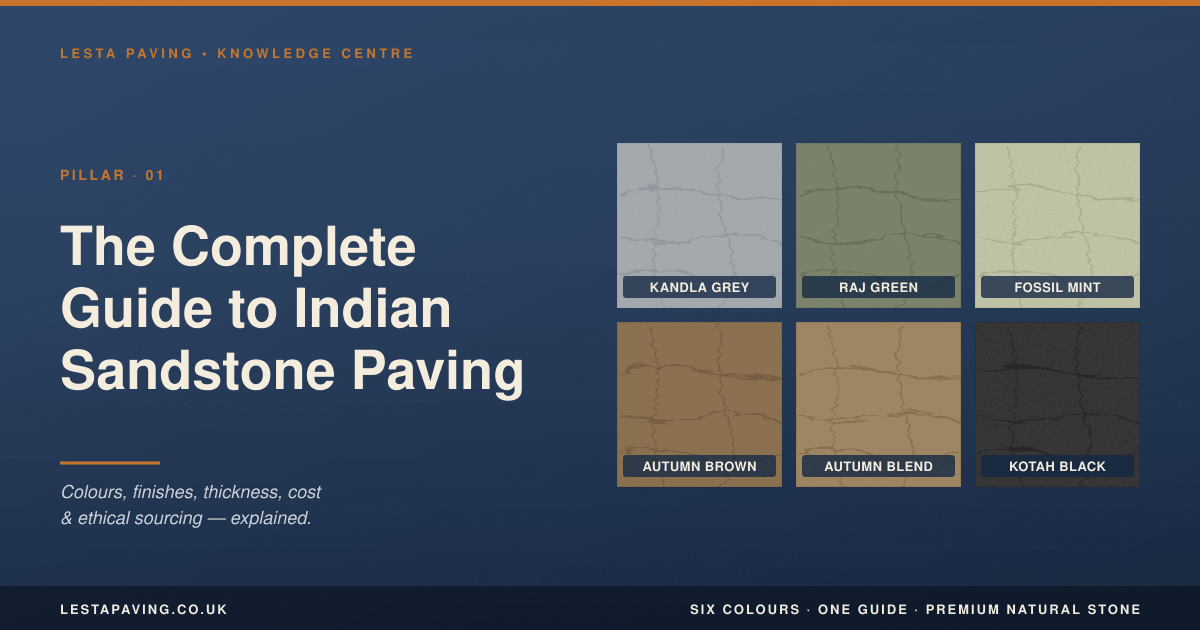
The Indian sandstone family includes a remarkable range of colours, each named for either its dominant tone or the region of India where it is quarried. The six that account for the bulk of UK orders are:
The most popular Indian sandstone in the UK by a clear margin. Kandla Grey runs from a soft pale grey through to a deeper slate-grey, with subtle variations slab-to-slab. It suits contemporary garden designs particularly well and works equally with light or dark planting. Available in both 18mm and 22mm calibrated thicknesses, and in single-size and patio-pack mixes.
A warm multi-tonal sandstone blending greens, greys and gentle browns. Raj Green is the bestseller for traditional and cottage-style gardens, and is also widely used in commercial landscaping because the colour variation hides everyday wear and weathering particularly well. Hand-cut edges and natural riven surface, 22mm calibrated.
One of the most distinctive options in the range. Fossil Mint carries soft mint, cream and gold tones with — true to its name — visible fossil detailing across many slabs. It is the choice for buyers who want their paving to feel one-of-a-kind, and pairs unusually well with planting in white, lavender and silver foliage.
The two warmest tones in the range. Autumn Brown is dominated by rich rust, brown and orange tones with the occasional darker plum-coloured slab. Autumn Blend is more varied, with the same warm range plus golds, ochres and the occasional grey. Both are at their best in late-summer and autumn gardens, against red-brick houses, and in any setting that suits a warmer palette.
Technically Kotah is a limestone rather than a sandstone, but it sits in the same product family for most retailers. Kotah Black is a deep, uniform black with minimal variation — ideal for contemporary minimal designs. Kotah Blue carries a distinctive blue-grey tone that is unusual in natural paving and works well as a feature material rather than a full patio.
There are three technical decisions to understand before buying Indian sandstone: thickness, surface finish, and edge treatment. Each affects appearance, installation, and lifetime cost.
"Calibrated" means every slab in the pack has been ground to the same thickness, which makes laying significantly easier and more accurate than working with uncalibrated stone. The two thicknesses you will see most often are 18mm and 22mm.
Most Indian sandstone is supplied with a "riven" surface — the natural surface of the stone, slightly textured, never two slabs identical. Riven is the traditional choice and accounts for the great majority of UK installations. It also provides natural slip resistance, which matters in a British climate.
The alternative is a sawn-and-honed surface, which gives a smooth, semi-polished finish suitable for both indoor and outdoor use and for transitions between the two (sometimes called an "inside-out" design). Sawn-honed slabs are typically more expensive and are usually 20mm rather than 22mm.
Most Indian sandstone is hand-cut: the edges are slightly irregular, with the natural fracture pattern of the stone visible. This is the aesthetic most homeowners actually want; it is what makes natural stone look like natural stone, rather than a manufactured tile. Some products — notably Kotah Black and the smooth stone range — are machine-cut for a cleaner, more contemporary edge profile. Both are fine; it is a question of design intent rather than quality.
Indian sandstone is priced per square metre. The current UK market spans roughly:
| Stone tier | Material price per m² | Typical project size | Material subtotal |
|---|---|---|---|
| Budget — 18mm calibrated | £18 – £22 | 20 m² patio | £360 – £440 |
| Mid-range — 22mm calibrated, common colours | £22 – £26 | 20 m² patio | £440 – £520 |
| Premium — 22mm calibrated, fossil/feature colours | £26 – £30 | 20 m² patio | £520 – £600 |
| Sawn-honed smooth stone | £28 – £32 | 20 m² patio | £560 – £640 |
On top of the material cost, you should budget for delivery (Lesta delivers free across most of the UK), the sub-base materials (sand, cement, MOT type 1), and either DIY labour or a landscaper. Professional installation in the UK typically runs £60 to £130 per square metre of labour, depending on region and site complexity. A complete, professionally installed 20 m² Indian sandstone patio therefore typically lands somewhere between £2,000 and £3,500 all-in.
A few things to look out for when comparing prices. First, check whether prices are quoted including or excluding VAT (Lesta always shows VAT-inclusive). Second, confirm that the price covers a full patio pack of mixed sizes, not a single-size pack at a teaser rate. Third, look for free delivery in the listed price rather than as a surprise on the checkout page. Delivery charges on a tonne of stone can add £80 to £200 to a quote.
Indian sandstone is the right material if you want a natural, characterful patio at a sensible price, and you are willing to give it a basic level of care once a year or so. It works for almost every garden style — contemporary, traditional, cottage, urban courtyard — because the colour range covers warm and cool palettes.
There are three situations where it may not be the right choice.
The Indian stone industry has had a complicated past. Reports of child labour, unsafe working conditions and unfair pay in some quarries — particularly during the 2000s — created legitimate concerns among UK buyers and led to industry-wide reforms.
Today, ethical sourcing is something the consumer should actively check on, and any reputable UK retailer should be able to explain. The key things to ask for are: (1) does the retailer have a direct relationship with the supplier, including in-person visits? (2) is the stone supplied through facilities that meet Indian labour standards (including the prohibition on child labour)? and (3) does the retailer have a documented sourcing policy?
At Lesta Paving, the answer to all three is yes. We have visited our supplier quarries in Rajasthan annually since the founding of the business, we work only with facilities that meet recognised Indian labour standards, and our sourcing policy is available on request.
With correct installation and basic maintenance, an Indian sandstone patio will last 25 to 50 years. The single most important factor in longevity is laying technique. Every slab must be bedded on a full mortar bed, not "spot-bedded" on five dabs. Spot bedding is the most common cause of premature slab failure in UK gardens — the slab cracks under load because it is unsupported underneath — and it is also a frequent cause of staining (water collects in the voids and brings minerals to the surface). A properly laid Indian sandstone patio simply does not have these problems.
The second factor is sealing. Sealing is optional rather than essential, but a sealed Indian sandstone patio holds its colour better, stains less easily and grows less algae. A single coat of a quality breathable sealer applied a few weeks after the patio is laid, then refreshed every 3 to 5 years, is the difference between a patio that looks new at year 10 and one that looks worn.
Beyond that, the maintenance ask is modest. An annual jet-wash on a low setting (high pressure damages the surface), an algae and moss treatment once every couple of years where shade encourages growth, and you are essentially done.
Indian sandstone is a sedimentary rock formed from compressed sand and silica. Indian limestone is a sedimentary rock formed from compressed calcium carbonate (often the remains of marine organisms). In practice, the most visible difference is appearance: sandstone is typically textured and varied in colour, while limestone is usually more uniform and dense, with a smoother, slightly velvety finish. Kotah Black and Kotah Blue are technically limestones, although they are usually sold alongside sandstones because they fit the same use cases.
Yes. Indian sandstone has been used across the UK for more than 25 years and performs well in all British climates, provided it is laid correctly on a full mortar bed and sealed appropriately. The combination of mortar bed and sealing prevents water ingress, which is the only way frost damage can occur.
Sealing is optional but recommended. A sealed patio holds its colour better, resists staining from food and drink spills, and grows less algae and moss. A water-based impregnating sealer applied 4-6 weeks after installation and refreshed every 3-5 years is the typical approach.
Measure the area to be paved in square metres (length × width). Add 10% for cuts and breakages on rectangular patios, or 15% for patios with curves, circles or irregular shapes. A standard 16.06 m² Indian sandstone patio pack contains 52 slabs across four sizes (900x600mm, 600x600mm, 600x290mm and 290x290mm).
Yes, Indian sandstone can be a DIY project for a confident homeowner, provided you have time and patience. The key is correct sub-base preparation, full-bed mortar laying, and proper jointing. See our paving installation guide for the full process. For larger patios, complex shapes, or homes with awkward access, a professional landscaper will save time and reduce risk.
A properly laid riven-surface Indian sandstone patio has good natural slip resistance in the dry, and acceptable slip resistance in the wet — it is more textured than concrete, slate or polished stone. For pool surrounds, wet-area patios or homes with elderly users, a sawn-honed Indian sandstone or an R11-rated porcelain may be a safer choice. Routine cleaning to remove algae also significantly improves wet-grip.
Indian sandstone is genuine natural stone with greater character and lower upfront cost; porcelain is a manufactured product with lower long-term maintenance, better fade resistance, and excellent slip ratings. For most UK gardens both are viable, and the decision usually comes down to design preference and maintenance tolerance. See our porcelain vs natural stone comparison guide for a full side-by-side analysis.
Calibrated means every slab in the pack has been ground to a uniform thickness — typically 22mm or 18mm. This makes laying significantly easier and faster than working with un-calibrated stone where each slab varies, and is the standard for premium UK installations.
Browse the full Indian sandstone range, or call our team on 0116 380 0545 to talk through your project. We deliver free across most of the UK and price-match against any reputable competitor.